It was a long drive to Cornwall to meet Pascale Petit, the place names sounding less familiar the further I travelled west: Plushabridge, Boddenick, Looe, Foye. Pascale’s home lay buried in a warren of narrow lanes, so narrow in fact that I wrecked the side of my car in a doomed attempt at a ten-point turn. I decided to reverse the rest of the way.
Pascale is a French-born British poet with eight collections to her name, four of which have been shortlisted for the TS Eliot Prize. Her work looks to the natural world for solace, healing and beauty in response to trauma. Reflecting on an otherwise bleak childhood, her spellbinding visions of nature give her a language for celebrating the saving grace of love.
Meeting me at the garden gate, Pascale was a vision in her Frida Kahlo-style garments, a bright red patterned jacket and floor length patterned skirt. She and her husband were still shielding from the pandemic, so we sat outside a safe distance apart. Her red outfit looked startling against the sap green backdrop of lush vegetation, as a glorious camellia bush arrayed itself behind her. Pascale is softly spoken but strong in character, a colourful person in her experiences as in her clothing, having journeyed to the Amazon and to the jungles of India. When I asked her why she doesn’t drive, she innocently replied there was too much backing up to do where she lived.
The September atmosphere was tranquil amid the deep shadows of the garden, and Pascale’s unconsciously composed body looked content and comfortable while I drew her. She talked freely about her childhood and cross-cultural heritage, her unstable mother and her love for her Indian grandmother, all themes she explores in her poetry. The dark chapters in her past helped me to understand her affinity for Frida Kahlo, who also turned pain into art. Pascale’s collection What the Water Gave Me contains poems in the voice of Kahlo, and some close readings of Kahlo’s work.
Similarly, after we discussed Pascale’s use of jungle metaphors – another collection, Tiger Girl,explores her grandmother’s heritage through the flora and fauna of the Indian subcontinent – I appreciated her fondness for Henri Rousseau’s magical painting Tiger in a Tropical Storm (Surprise). Rousseau also had a truly poetic imagination, in that he was able to conjure this tropical scene without ever leaving Paris. This conversation prompted me, some months later, to make a pilgrimage to the botanical gardens that inspired him, the Jardin des Plantes.
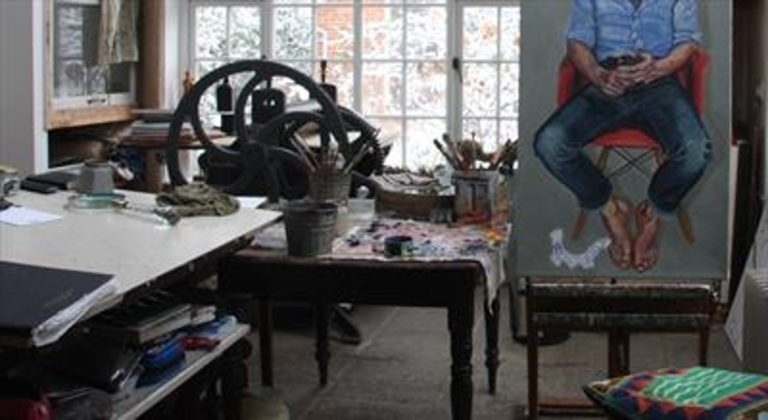
It was already late spring when I started work on Pascale’s portrait. On my way to the studio I stopped by the tree fern, recently unrobed from it’s hessian winter coat, and looked for signs of new fronds beginning to unfurl. It was still chilly, and the daylight not yet bright enough for painting, but I love the early morning smells and atmosphere of the studio this time of year.
As I began to cover the canvas with bold green brushstrokes, I thought back to the sitting with Pascale, her garden bathed in sunlight, Rousseau’s tropical forests and Frida Kahlo’s enigmatic symbolism. I wanted the portrait to invoke the rich, gentle atmosphere that surrounded our first meeting.
For inspiration, I turned to Kahlo’s Self Portrait with Thorn Necklace and Suzanne Valedon’s Black Venus, both paintings with figures in front of leafy backgrounds. But as I tried to draw on these examples, I became aware of my own unresolved relationship with the natural world. There is something deeply satisfying in Kahlo’s careful rendering of nature’s intricate forms, but I find Valedon’s expressive use of saturated colours no less appealing. Pascale’s portrait gave me the opportunity to find my own synthesis of these styles.
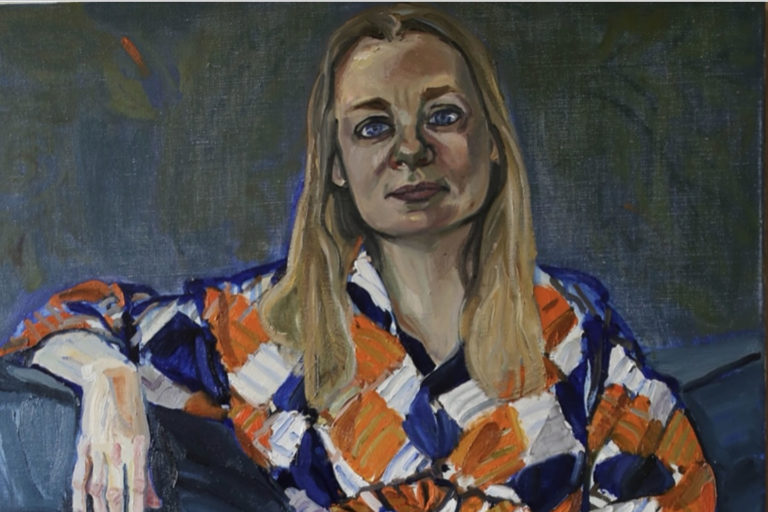
The predominance of red and green provided this painting with a firm visual foundation, since these are complimentary colours, while also raising some interesting narrative possibilities. Red is sometimes suggestive of anger, but in the case of Pascale’s garments it could be understood as a symbol of suffering, met and soothed by the restorative setting of the garden. This seemed like a fitting echo of Pascale’s own work. I also decided to include a pair of feline eyes in the shadowy recesses of the background, an allusion to her poetry of jungles, tigers and childhood memories.
I was very grateful when Pascale made the journey from Cornwall for a second sitting in August. She loved the colours of the painting and especially the tiger eyes, but felt I had aged her too much with my bold outlining of her facial features. I wasn’t committed to the face as I had painted it, so I was happy to try again. Noticing that her hair had grown since our first meeting, I made a few changes here too, focusing on the distinctive way she arranges it with a plait-shaped Alice-band.
It’s rare that I get a chance to paint a portrait as lyrical as this one, challenging me to bring together nature and memory and poetry. Artistic opportunities like this were just what I hoped to find by painting writers.