In November I took the train to Stoke Newington, northeast London, to meet Ayisha Malik. As I walked the final stretch I peeked in at the shop windows, enjoying the spectacle of a thriving cosmetics industry: one man was getting a full head tattoo, another having his highlights done by a hairdresser clad in leather and chains. Stoke Newington itself is like a picturesque village stranded in the metropolis, with plenty of listed buildings and no shortage of prams. The area seems to be having an unrivalled baby boom.
Arriving at Ayisha’s Georgian terraced house, I was taken aback by her luxuriant head of hair. I had only seen photos of her in which she covered her head with a hijab. She was wearing her usual writing outfit, which she calls her pyjamas: tracksuit bottoms, an elegant dressing gown and socks.
We went to the living room, where she had placed a side chair underneath a panelled mirror as the setting for her portrait. She joked that her mother would be appalled at the clothes she had chosen, which I found very relatable. Does the feeling of our mothers looking over our shoulder ever go away? I am in my 60s and still vulnerable to my mother’s criticisms, though she has long since parted from this life. Reading Delacroix’s journal once I was amazed to find that even he worried about making his mother ashamed.
Ayisha settled in for the sitting, crossing one leg underneath her and pulling the other in close to her body. The mirror, reflecting cupboards and utensils from the kitchen, provided an interesting rectilinear element in the middle of the composition. I included it in both of the drawings I made with colouring pencils. I was also sure to draw Ayisha’s bangles, which she described as an essential part of who she is.
Ayisha seemed relaxed and comfortable as I studied her, and talked to me about her Muslim faith. We discussed the discipline needed to set her alarm for the first prayer at sunrise, and the importance of community for sustaining the faith and providing a sense of belonging. I remarked that it must be difficult to avoid distraction in a secular society, but she assured me she has many friends who share her beliefs and Pakistani heritage. As for the hijab, Ayisha told me she had made a decision to stop wearing it, though this did not make her any less devout.
The Muslim experience has been central to Ayisha’s writing. Her novel Sofia Khan Is Not Obliged was modelled on Bridget Jones, describing the world of Muslim dating in the form of diary entries. Similarly, The Other Half of Happiness focuses on Muslim marriage, while This Green and Pleasant Land is an inquiry into faith and identity. Ayisha also does some ghost writing for other people, which apparently has the benefit of taking some of the pressure off a book’s reception.
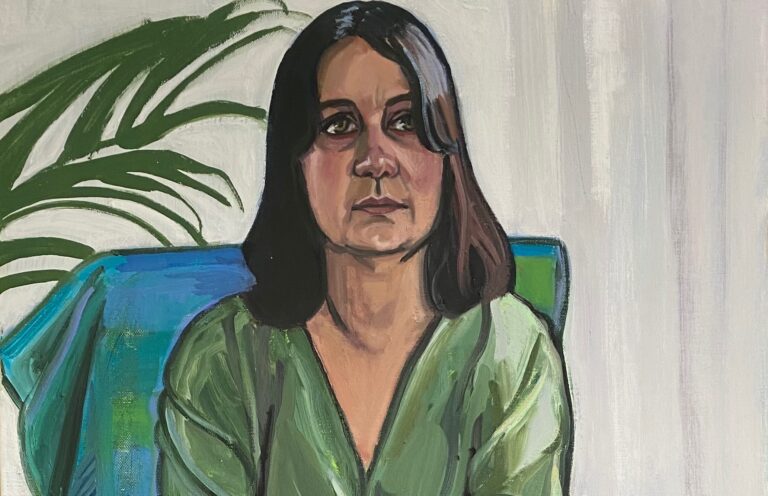
When I transferred my drawing of Ayisha to canvas, I found her pose provided a strong pyramidal composition, which I emphasised by bringing the figure forward as far as I could. There was a pleasing pattern combination between her gown and the chair, while the red cushion
sandwiched behind her back introduced a welcome splash of colour amidst the grey tones. All of this was nicely tied together by the light pouring in through the window, which illuminated Ayisha’s profile and broke up the background as it gathered on the floor and walls. I thought the flaps of torn fabric under the seat were an interesting detail.
What I really wanted to focus on, though, were Ayisha’s thick spools of hair and her straight, soft but rather serious gaze. These features conveyed a mixture of intimacy and confidence that I felt could make for a powerful portrait. Realising this potential, though, became a rather daunting challenge when it transpired there wouldn’t be time for a second sitting.
I needed to be bold and tackle Ayisha’s expression without the safety net of examining her close-up in the studio. What galvanised me for this task was a superb exhibition I saw around this time at the Musée du Luxembourg in Paris, on women artists in the 1920s. I carefully studied portraits by Suzanne Valadon, Mela Muter, Tamara de Lempicka and Nina Hamnet, observing their daring commitment to making their subjects appear unique and distinct.
Once I was happy with Ayisha’s expression, I finished the painting with the mirror behind her head, where I repeated the red of the cushion and the yellow of the floor to make a kind of miniature Mondrian composition. Such apparently minor elements in a painting can be deceptively important, binding together different motifs that would otherwise become tangential, almost like the keystone of an arch.