Road works sabotaged my journey to Kent for my first sitting with Diana Evans, the gorgeous June weather mocking me as I crept along in traffic for two hours. I was listening to an audiobook about Lucian Freud, a sublime painter but not exactly a role model, and contemplating if one can separate the artist from the work. My own art is very personal, inseparable from who I am, though not an expression of something unchanging. It is through my art that I discover myself, and there is always more to be discovered.
Diana was guarded at first, and I was slightly nervous, being aware of her literary achievements. I found Diana’s most recent novel, Ordinary People, an incredibly poignant portrayal of modern life and relationships on the cusp of middle age.
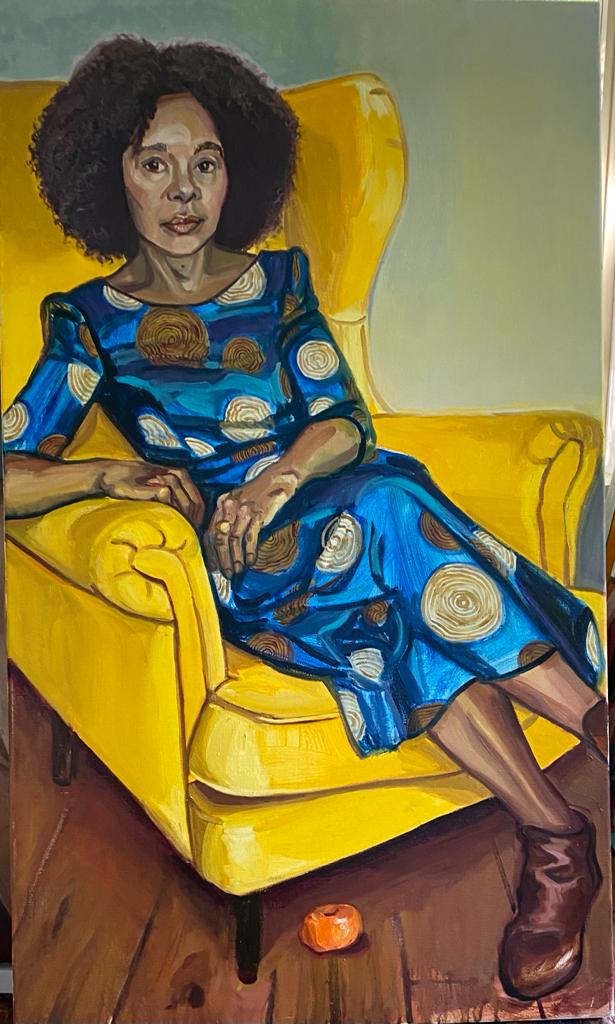
We talked about where she would sit, weighing up her blue living room sofa, a yellow high-back chair in the dining room and a pale blue chair in her office, which we reached via a narrow spiral staircase. Then she showed me three stunning dresses in Nigerian patterned fabric, which she had made herself (I have to confess I was envious). We chose a l’heure bleue dress and decided it would look great on the bright yellow chair, which almost swallowed Diana’s petite body. Finally, a decision had to be made about glasses, which she preferred to go without. I thought she looked very paintable.
As I drew her, I glanced occasionally at the pictures of inspiring figures on the walls: Tony Morrison, Cassandra Wilson, Lynette Yiadom-Bokaye, Barack Obama. We talked a little about race, which always makes me feel conscious of my shameful South African background. Diana said in her opinion the best book for understanding race relations was Reni Eddo-Lodge’s Why I Am No Longer Talking to White People About Race.
Towards the end Diana and I were chatting and laughing freely. I am always delighted when my relationship with a sitter moves past its initial awkwardness. It’s not unusual for sitters to be hesitant at first, especially if they are unfamiliar with the intrusive sense of scrutiny that comes with being drawn, and I can only hope that getting to know each other a little through conversation helps them feel more relaxed.
I started painting Diana’s portrait in November. I used Paris blue for her dress, a dangerous choice because its exceptional strength can wreak havoc on your palette. For the floor I used Michael Harding’s amethyst, a new colour for me and a pure joy on account of its incomparable richness. It is especially good for mixing with ivory black, which otherwise becomes dull when it dries, and it works well in skin tones if used sparingly. I spent some time puzzling over how I should paint the circles on the dress. As always I wanted to avoid being too precious, since this can drain the spontaneity from a painting, but I did want to capture the distinctive folds of the stiff fabric and the colour of the chair echoing in the garment’s pattern.
Returning to the portrait a few days later, I found the amethyst actually too rich for the floorboards. Nor was I pleased with the background (Diana had been sitting against a pale grey wall). I turned to Kokoshka’s portraits for inspiration, in particular his painting of Martha Hirsh, titled Dreaming Woman. This then put me in mind of František Kupka’s self-portrait The Yellow Scale. I decided to experiment with yellows in the background, hoping this would give me an idea about what to do with the floor.
Diana came to my studio for the second sitting at the end of January. I had laid out my brushes in preparation, using as my palette the glass top of a medical trolley I inherited from a retiring surgeon, an old acquaintance of mine. This trolley came with me through the rupture of my move to England 27 years ago, and to this day its value is sentimental no less than practical.
By this time I had arrived at a pale green background and reddish brown floorboards. I was pleased with how the painting had progressed: it captured Diana in the way I had experienced her and as I remembered her. Our second meeting was warm and familiar from the outset, Diana sitting patiently while I painted. I spent a lot of time on her hair, an integral element of the portrait and wonderful to paint, but requiring an attention to light and detail that a photo reference cannot provide.
This time we talked about her award-winning first novel 26a, which I downloaded as soon as she left. It is a moving, inspirational memoir about twin sisters growing up in London. As I listened, I remembered Diana describing to me the profound void left by her sister’s death. The twins in 26a often share tangerines, so I decided to add one in to the painting. I was thinking about Otto Dix’s portrait of the poet Ivar von Lücken, with its pair of pale yellow roses in a beer bottle. Those roses always fascinated me, and I have come across at least three different interpretations of their meaning, my favourite being that they signify a life dedicated to the pen.
Similarly, although I added the tangerine to Diana’s portrait, the symbol belongs to her and only she can truly know what it means. The rest of us will just have to guess.