I was driving to the coast again in June, this time to meet Alicia Foster at her home in Folkestone. Alicia is an art historian, curator and novelist. Her first novel, War Paint, tells the story of four women making artistic propaganda for the war effort in 1942-43, and she has written a book on the fascinating designer and writer Nina Hamnett.
Alicia welcomed me at the front door and led the way to her living room. For the sitting, she sat on a fiery orange sofa upholstered in panne velvet, with a teal green wall in the background. She mentioned that the blue and white stripy shirt she wore was her favourite at the moment, adding (quite rightly) that stripes are always fun to paint. As I drew, Alicia talked about Gwen John, the early-20th century Welsh painter she was curating, and how complicated her job has become due to the reluctance of institutions to lend works.
Alicia’s Bengal cat was curled up next to her, curious about my presence and activity. He looked paintable on his white and black striped cushion, though he was far from a passive subject. After a series of mewling conversations with Alicia, he departed from the room. The next moment we heard a lot of squawking and complaining from the corridor, where he was evidently bargaining with a bird.
Cats are many-sided creatures, which makes them wonderful subjects for painting. Often they are portrayed as sullen or docile, but Picasso and Goya have captured their predatory instincts; the preying of cats upon birds is a rich symbolic motif. The abundance of cats among my subjects in this portrait series was a real bonus, though I shouldn’t be surprised. As Ursula Le Guin said, writers have a special preference for cats because they don’t want to break off their work to walk the dog.
Maybe this is one of the ways painters and writers are different. While I love drawing cats in all their fantastic poses, I find dog-walking a welcome break for reflecting on the day’s progress, allowing me to revisit important passages in my mind’s eye and return with a fresh perspective. Besides, the sheer unbridled joy of a dog on a walk cannot help but lift your spirits.
I did two drawings of Alicia, including the cat and her ever-present notebooks. I liked how she presented herself with a slight side-angle. She came across as self-assured and confident, comfortable in her skin, and I very much appreciated her saying that she really didn’t mind how I portrayed her. People are often nervous about the way they are represented, which is understandable: we are all vain in one way or another, myself included. But sensing expectations from a sitter inhibits me hugely, making me paint in such a way that I sometimes cannot recognise myself as the artist.
More specifically, I often like to exaggerate some aspect of a sitter for the sake of a more interesting and powerful portrait. I find myself struggling against this impulse if I am worried about causing offence.
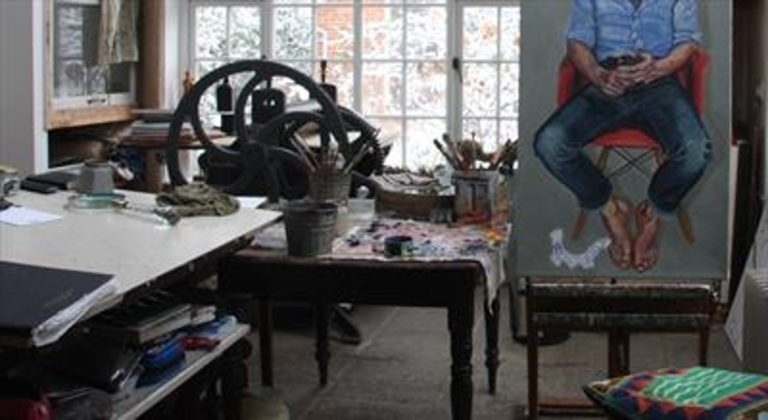
It was a blustery day in late August when I started to paint. The studio doors were wide open, the temperature still pleasant and warm, but the leaves blowing in reminded me of autumn approaching. Transferring my drawing of Alicia onto canvas, I liked how the sofa divided the composition into thirds. After covering big sections in broad strokes of acrylic, I painted the figure in oil with subconscious ease, probably because I felt Alicia would be accepting of the result.
Another advantage of not being over-concerned with an accurate or flattering representation is that you feel freer to explore the subject’s aura. This is the atmosphere a person brings into a room, the distinctive quality of his or her presence. Aura, as Lucian Freud rightly said, is as much part of the subject as their flesh. It is bound up with a person’s character as intimately as voice or smell, and it informs the feeling a painting should give out.
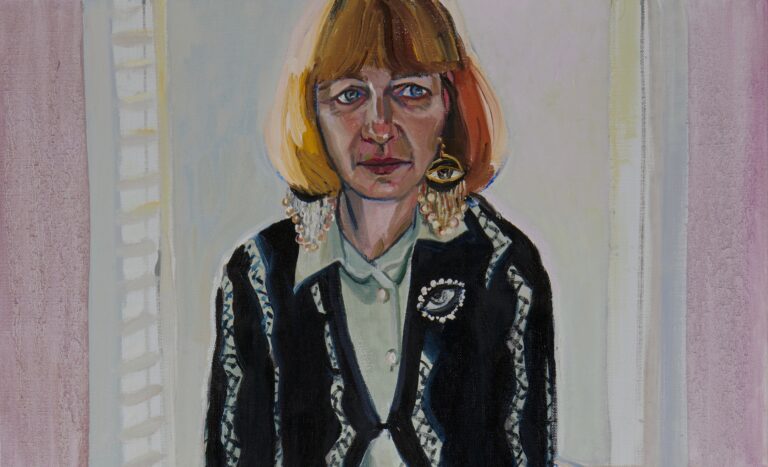
But as my portrait of Alicia hopefully demonstrates, capturing an aura is not the same as somehow laying a subject bare to the viewer. Despite her self-assurance, I found Alicia to be very enigmatic, always an interesting quality in a sitter. Not for the first time, I was trying to represent something paradoxical in this portrait: a particular sense of ambiguity.